
Compare Life Insurance Plans and Find the Best Coverage for Your Needs | Spring Money
- Nisha Mantry

- Dec 8, 2022
- 4 min read
Updated: Jul 21, 2024
While Suhana understood the importance of life insurance through Rohit’s Story, she was now confused about which life insurance plan would be the most suitable for her according to her needs. To help Suhana pick the most appropriate plan for her, we have prepared a list of different life insurance plans available and their features so that she can choose the one that benefits her and her loved ones the most.

Types of life insurances
Term Life Insurance
Term life insurance is a type of insurance policy where the insurer agrees to pay a sum of money to the policy’s beneficiary in the event of the policyholder’s death. The term is usually set for a specific number of years, such as 10, 20, or 30 years.
The policy does not have an investment component, which means that the policyholder does not build up any cash value over the life of the policy. Term life insurance is typically less expensive than whole life insurance, which does have an investment component.

This insurance is a good option for people who are looking for a simple, affordable way to provide financial protection for their loved ones in the event of their death.
Whole Life Insurance
Whole life insurance provides recipients with lifelong coverage. This type of insurance is also known as “permanent life insurance” because it does not expire like term life insurance.
A whole life insurance policy also has a “cash value” component that allows the policyholder to access cash value through loans or withdrawals. The cash value can also be used as collateral for a loan.
The factors that make these plans unique are the cash value build-up, guaranteed level premiums, and death benefit protection. Whole life insurance policies are one way to help ensure that your loved ones are taken care of financially in the event of your death. These policies can also be used as part of a larger financial strategy, such as estate planning.
Unit Linked Insurance Plan (ULIP)
Unit Linked Insurance Plan (ULIP) is a type of insurance plan that offers investment and insurance benefits. It provides coverage for the policyholder’s life and helps grow the policyholder’s wealth. The investment component of ULIPs is linked to specific investments, such as stocks, bonds, or mutual funds.
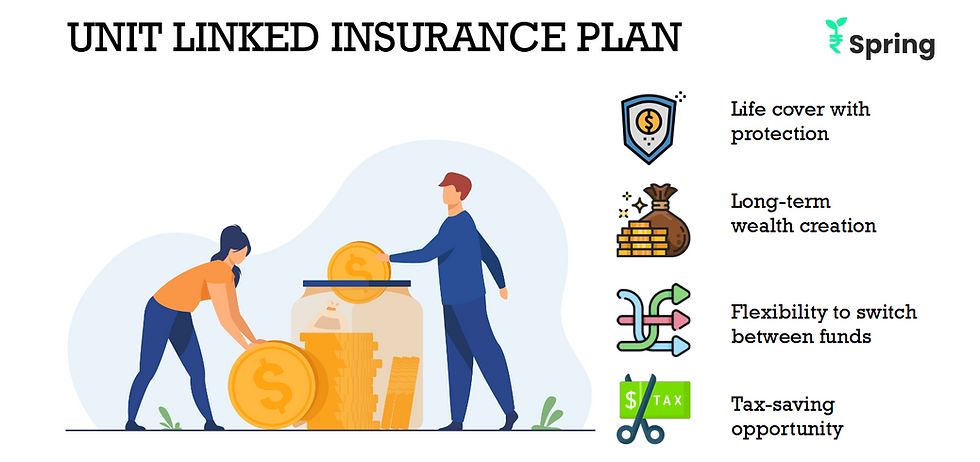
ULIPs have lower premiums than traditional life insurance policies and offer the potential for higher returns on the investment portion of the policy.
These policy plans have several features, including death benefits, cash value growth, maturity benefits, and the ability to make partial withdrawals. ULIP plans are a popular choice for many people because they offer the potential for both investment growth and insurance protection.
Endowment Plan

A sound endowment plan helps individuals and organizations save money for a particular purpose. An endowment plan's main features are a guaranteed cash value and a death benefit. The cash value of an endowment plan grows tax-deferred and can be accessed through loans or withdrawals. The death benefit is paid to the beneficiaries of the policyholder when the policyholder dies.
These are long-term investment opportunities that involve a lump-sum investment at the beginning with returns at maturity of the plan.
Money-back Plan
A money-back plan is a type of insurance policy that allows policyholders to receive periodic payments, known as survival benefits, while they are still alive. The policyholder can use these survival benefits for any purpose, such as supplementing their income, paying for medical expenses, or funding their child’s education.
In addition to the survival benefits, the policyholder will also receive a death benefit when they die. The death benefit can cover final expenses, such as funeral costs, or it can be given to the policyholder’s beneficiaries.
Child Insurance Plan

A child insurance plan is an insurance plan taken out by parents to financially secure their children in case of any unforeseen circumstances. The features differ from insurer to insurer, but generally, the policyholder can avail of a death benefit, which pays out a lump sum to the beneficiaries in the event of the policyholder’s death which can be further used to an be used to pay for your child’s education, medical expenses, or any other expenses that your child may have.
There is also typically a maturity benefit, which pays out the sum assured plus accrued bonuses upon the policyholder’s survival to the maturity date.
Group Insurance Plan
A group insurance plan is an insurance that is provided by an employer to its employees. It is a combination of health insurance including coverage for doctor visits, prescriptions, hospitalizations, and immunizations, life insurance, disability insurance, and long-term care insurance. Group insurance plans are a way for employers to provide their employees with financial protection in case of an unexpected death or illness.

Savings and Investment Plans
As the name suggests, a savings and investment plan is a way to set aside money regularly so that it can grow over time. The features of a savings and investment plan vary. Still, they typically include some combination of the following: the ability to save money each month, the ability to invest money in a variety of different investment options, and the ability to withdraw money from the account when needed.
The money that is put into a savings and investment plan can be used for various purposes, such as retirement, a child’s education, or a down payment on a house. There are many different savings and investment plans, such as 401(k) plans, Individual Retirement Accounts (IRAs), and 529 plans. Each type of savings and investment plan has its own set of rules and regulations.
Ending Thoughts
By assessing your financial situation, life insurance goals, and other factors, you can choose the best insurance that will protect you and your loved ones in uncertain times. Choosing the right plan isn’t a difficult task. All you need is to understand your objectives, know about different plans and their features and pick the one that can benefit you the most.
If you are facing difficulty choosing life insurance, check out our blog to understand how you can choose life insurance.


Comments